The post Cushioning the Blow appeared first on Hosting With Heart.
]]>Let’s look at the inside first – because that’s the tricky bit. Most cushion fillers are made from polyester (plastic, in other words). The cheap fillers go flat as a pancake very quickly. A when they go flat you will likely throw them out and buy a new inner, right? Or you might even throw the whole cushion out. If you buy another cheap filler, the same thing will happen again. Often the cheap fillers fall apart, leaving a cascade of horrible microplastics spreading everywhere: it makes such a mess.
Is there a biodegradable cushion insert? Well, yes – feather or down. But there are also issues with these. Allergy issues, fair labour issues and, most disturbingly of all, animal welfare issues. (Have. you heard about live plucking? I’ll leave that to you to investigate. You will need a strong stomach.) So let’s forget about feather and down-filled cushions…

What about cushion inners that have been made from recycled plastic PET bottles? Well, I’ve looked into these. On first impression they sound like a good option – at least the inner is made from a recycled item – plastic bottles. But I’ve probed a little further – I’ve asked if you can recycle the cushion inner that’s made from a PET bottle when the inner is at the end of its life, so it can go round again. The answer is no.
So, biodegradable (feather and down) cushion inners are an ethical nightmare and there is no recyclable cushion inner. What do we do? Well, all we can do is do our best in an imperfect world. Here are some things you can consider to cushion the blow of the cushion:
• Reduce – How many cushions do you really need? Ever stayed at a place where you need to put half the cushions on the floor just to sit down on the couch? What else could you use to decorate your lounges?
• Reuse – Buy cushions with zippers so you can remove the inner when it fails and so you can wash and reuse the cover.
• Buy biodegradable cushion covers – Cushions covers made with natural fibres. Wool, Linen, Cotton. Not polyester or polyester blends. Natural fibres will compost and biodegrade.
• Buy quality – Buy cushion inserts that are guaranteed to have a long life, so when the inevitable happens and the inner needs replacing, you have kept it out of the waste stream for the longest period possible. Ask the retailer or manufacturer.
• Make your own cushions – found some retro fabric at the Op shop that would make the perfect cushion? Making your own means it’s your labour going into a beautiful, unique item. You get to appreciate the labour that goes into making such frequently disposed of items. Making your own means you avoid the possibility of unfair labour practices by homeware empires (which often use sweat shops).
I am sure you have other suggestions for decorating your lounge chairs and beds – I’d love to hear them and maybe you have recommendations for quality cushion inners.
Here is one supplier you might want to consider, but I’m sure there are others – tell us who you have found!
MicroCloud Bedding – https://www.
The post Cushioning the Blow appeared first on Hosting With Heart.
]]>The post Earth Overshoot Day and the consumption of setting up a stay appeared first on Hosting With Heart.
]]>In other words, Earth Overshoot Day is when our consumption has exceeded the ability of the Earth to replenish itself.
In 2022, Earth Overshoot Day was alarmingly on 28th July – 5 months before the end of the year. It is estimated that in 2022 humans consumed 1.75 times the planet’s renewable resources. That clearly cannot continue.
Setting up a stay involves so much consumption, so we are part of the Earth Overshoot problem. We can lessen our contribution to the problem in the choices we make. Each stay is different, but how many new things – I mean brand new – do we actually need to buy to set up a stay?
Probably the only essential new things are mattresses and towels and pillows (for health reasons) and electrical goods (for safety reasons). Most other things to fit out and furnish your place need not be new consumption at all. Tableware, furniture and decorations can all be purchased secondhand, pre-loved, retro.
Setting up a stay involves so much consumption, so we are part of the Earth Overshoot problem. We can lessen our contribution to the problem in the choices we make. Each stay is different, but how many new things – I mean brand new – do we actually need to buy to set up a stay?
Do your plates and cups and bowls really need to match? You can find the loveliest retro-style plates etc in op shops. Pick a theme – autumn colours, pretty roses, ’50s geometrics – and hunt down tableware that suits your stay. It’s fun, your place will be unique, and secondhand tableware doesn’t contribute to Earth Overshoot.
Same goes for furniture and decorations. You can find unique pieces in antique and secondhand shops and there are loads of online sellers. Artwork? Do you really want that cheap print from Freedom? Find a local artist that makes the most beautiful work and hang something truly original. Or hang a branch, a nest, a handmade wreath from materials gathered from your garden.
If you want to buy new tableware, then consider buying commercial ware – the stuff that restaurants and cafes use – it doesn’t break! And consider supporting your local non-chain homewares store – they will stock commercial ware.
If you need to buy a new item, then consider buying:
- locally made
- from a local business
- items made with fair labour practices
- items with low kilometres
- from an artist or artisanal maker
- things that can be composted
- things made with recovered or recycled materials
- natural fibres only
And one of the most important things you can do is buy excellent quality, so you only buy once!
I am sure you have many more suggestions than these – this is just a start. This is not sackcloth-wearing penury: you can still have a beautiful stay and lessen your impact. And we don’t have to be perfect, but we can all do better.
Feel free to ask me how we have fitted out Kestrel Nest Eco-Hut!
Check out:
Earth Overshoot Day – www.overshootday.org
And #movethedate
The post Earth Overshoot Day and the consumption of setting up a stay appeared first on Hosting With Heart.
]]>The post Curating a Beautiful Home with Pre-loved Treasures appeared first on Hosting With Heart.
]]>Australia’s obsession with interiors comes at a cost. A recent furniture rubbish survey found the Greater Sydney region can generate as much as 48,000 tonnes of furniture waste yearly – covering both soft furnishings and hard furniture.
Team that up with waste from packaging, carbon from freight, rising inflation and supply chain delays, and we’ve got an expensive, wasteful habit that requires a lot of patience before that fancy new sofa arrives.
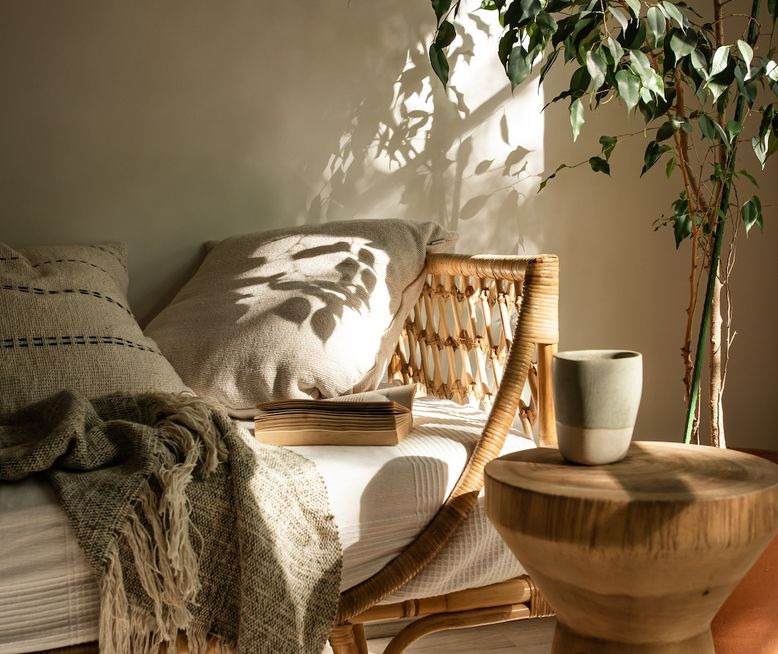
Second-hand is sexy, for so many reasons:
-
- It’s sustainable: no packaging. No freight. No waste. No landfill.
-
- It’s affordable: as a rule of thumb, for quality pieces, pay at most half the cost of the same item new in-store.
-
- It’s convenient. Don’t wait three months for a new chair and then decide it’s not right for the space. With online marketplaces, it’s never been easier to find just the thing you need – and so often, it’s just around the corner, and you can pop over and pick it up tonight.
-
- If you stuff up and buy the wrong thing, you can just put it on the market again, straight away. Take a good picture, and sell it at a profit 😉
-
- It’s timeless. Think about it: if you waltz into the shops and kit your home out with all the latest and greatest from 2023, your home will always look like it came from 2023. BUT if you curate it using a mix of vintage and modern finds you’ll have a storied home, full of character that lasts the test of time.

For our hosted home, called The Kindred, Canberra, we wanted to prove what’s possible when you buy nothing new. Everything there, except the bedding and towels, is either preloved or hand made. Every spoon, chair, shelf, tap, hook, rug and coat hanger. It’s the third home we’ve furnished this way, and here’s what we’ve learned:
- Decide on a style and colour palette that’s inspired by your home and its surroundings. You will be tempted by bargains that don’t match your style. Let them go: a cohesive look will elevate your space.
- Great preloved markets include facebook marketplace, gumtree, online vintage sellers, local buy/sell/swap groups, council clean-ups, tip shops and second hand shops.
- Make sure you ask for measurements if they’re not on the listing, and check carefully for any evidence or mention of damage. Don’t discount it if something’s beautiful but broken. Youtube is great for fix-it tutorials, and if you’re still not sure, take it to your local men’s shed and they’ll fix it for a song.
- The second hand market is generally very quick, so it helps to be on the ball. Create alerts for things you need and be specific: for example, “outdoor timber daybed” within a certain radius. You’ll be the first to know when the right thing pops up.
- If you find a vendor selling things you love, check what else they have listed. You can also follow vendors on facebook marketplace to be alerted of new listings. I follow some stylists in Sydney who sell homewares they use in shoots. I also found and follow some people who work in the warehouse of designer furniture stores, and list their floor stock or samples. They often won’t divulge the brand to keep people buying full-price from the store. In this case it helps to know what you’re looking at to recognise the brand and understand the value, but if you don’t, you can try a reverse google image search.
- On haggling: go for it, but know that you risk losing it to someone else. Check how many folks have saved the item first. Generally, items like bed frames and sofas are great for a bargain as people need to clear them out before they receive a new one. Quality armchairs, outdoor teak furniture and classic dining chairs are rarer. Pounce on these, and don’t bother haggling.
- If something is very popular, or even if someone else has just said they want to buy it, don’t be afraid to offer a bit more than the asking price. Until the item’s been picked up, you’re still in with a chance as buyers can be no-shows. Also offer to pay a deposit and to pick things up quickly.
- For hard-to-find items, enlist the help of family and friends in different cities to broaden your search.
- Online auction houses like Lawsons or Davidson Auctions are brilliant for preloved original art and quality kitchenware. They often represent folks offloading an entire household worth of goods from wealthy collectors. You can kit out an entire kitchen, and can find some incredible artworks for a song – it beats buying mass-produced prints that you’ll see popping up everywhere, and helps create a high-end look.
- If you can, concentrate your searches on higher density, affluent suburbs: this goes for both online marketplaces and council clean-ups. If you’re far away from a big city, a buying trip can be a good investment. Hire a trailer, line up purchases to pick up in a single day (pay a deposit to the vendor so they’re happy to hold it), and make a day of it.
Good luck hunting. To find out more about The Kindred, follow us on Instagram at @thekindred_canberra, or visit our Hosting with Heart listing.
The post Curating a Beautiful Home with Pre-loved Treasures appeared first on Hosting With Heart.
]]>The post REVIEW: Life Unhurried appeared first on Hosting With Heart.
]]>The authors, Celeste Mitchell (our former HWH podcast guest), Katie Gannon and Krista Eppelstun present a compelling and visually engaging argument for why it’s important to take a step back and live life at a more leisurely pace.
Throughout the book, the trio – also the founders of the highly successful directory website and blog of the same name – draw on personal experiences, research and artfully written summaries of a spectrum of sustainable stays, from the humble and tiny to the large and luxurious, to illustrate the many benefits of slowing down.
They touch on topics such as mindfulness, work-life balance, and the impact of technology on our lives, and provide practical tips and exercises to help readers incorporate the principles of unhurried living into their own lives.

One of the standout aspects of the book is the writing style, which is engaging, relatable, and often humorous. Celeste, Katie and Krista have a way of making complex ideas accessible and understandable, and the book is filled with insightful quotes and anecdotes that drive home the message of the importance of taking life at a slower pace.
Overall, I found the book to be a really enjoyable read. The only minor criticism would be the lack of discussion around the accessibility features of many of the properties profiled, but that’s admittedly not Life Unhurried’s bag, but ours here at Hosting With Heart.
Whether you’re someone who is feeling overwhelmed by the pace of modern life or just looking for ways to live more mindfully, I would highly recommend getting your hands on this book. It’s a great reminder to appreciate the beauty in life’s smaller, fleeting moments, and it’s sure to leave you feeling inspired and refreshed.
A heartful thumbs-up.
Get your copy of Life Unhurried here.
Published by Hardie Grant, 2022.
The post REVIEW: Life Unhurried appeared first on Hosting With Heart.
]]>The post REVIEW: Cheeky Squirt Bum Wipes appeared first on Hosting With Heart.
]]>It has come to my attention that a certain cohort regularly wipes themselves with wet wipes and then flush them down the toilet. And unlike regular toilet paper, these do not break down.
You may be in one of two (booty) camps: the wet-wipe users or the wet-wipe novices. If you are a regular wet-wipe user, please keep your tush firmly seated until the end as I have lots to share with you. As for the novices like myself, there is much to learn about the world of wet wipes and clean derrieres.
But first, a story:
Many years ago, when I was a young arts student, I was invited by an older, more mature student to their house for a dinner party. Having never been invited to such an event, I panicked at the bottle shop, unsure which of the many white wines would be a suitable offering. Thus stumped, I chose the most foreign-looking one, with a name I could not pronounce. Was it German? Swiss? I had no idea, but with it I hoped I’d come across as sophisticated.
The wine was uncorked at dinner and received with a frown from the host. I took a quick sip and realised I had delivered a bottle of sickly-sweet dessert wine. Mortified, I headed to the bathroom to compose myself and it was there I saw for the first time, by the toilet – a packet of wet wipes for general use. The moment is burned in my memory as I couldn’t work out the mechanics of such a product. One wipes oneself and then … flushes it down the toilet? Was this what mature, middle-aged people do?

Now a middle-aged person myself, and having birthed a child and experienced a glittering array of health issues which require a tender touch, I understand the appeal of a soft wet wipe on one’s rear end. But there is the environment to consider. One can’t just go around tenderly touching one’s arsehole with single-use products that contribute to climate change in the hopes that one day all will be forgiven (it won’t, dear reader).
Billions of wet wipes containing plastic are flushed down toilets every day, causing havoc in our sewer systems and creating foul pollution. Dear reader, know that I am only too sympathetic to those who see wet wipes as a necessary part of their day-to-day life. Every bottom deserves a sensitive solution, but so too does our environment, which is where Cheeky Squirt comes in.
Cheeky Squirt is an ideal product in so many ways. It cleans your bum (check) doesn’t harm the earth (check) and it can be used in septic tanks – for an off-grid-living greenie like myself, this is a big win. Having used Cheeky Squirt for some time, I can now say, hand on bum, it’s a peach. The process is simple: one cheeky squirt on toilet paper as you go about your business and voila, clean as a whistle!
As a wet-wipe novice and bidet-curious individual, it’s been a satisfying journey with Cheeky Squirt, one I would recommend to everyone!
Visit www.cheekysquirt.com.au for more info and/or to order today.
The post REVIEW: Cheeky Squirt Bum Wipes appeared first on Hosting With Heart.
]]>The post Why Sustainable Tourism? appeared first on Hosting With Heart.
]]>From bushfires to floods and damaging storms, we are already experiencing the devastating consequences of climate change. This has been a wake-up call for everyone, from individuals to whole industries. And like other sectors of the economy, the travel industry needs to do its part.
But are our guests on board? Do they consider sustainability when they book a holiday? Evidence suggests that they do – increasingly so.
A study by Expedia of travellers from 11 countries shows that guests are well and truly considering issues of sustainability when selecting a travel destination and experience. They report a staggering 90% of consumers look for sustainable options when travelling.
And furthermore, guests understand that supporting local communities is part of sustainable tourism – that is, they have a nuanced understanding of what sustainability means, as explained in my first post.
Here is how guests from the Expedia study define sustainable travel:
- 69% lessening environmental impact
- 66% supporting local economies
- 65% supporting local cultures and communities
While travelling in the previous two years:
- 3 out of 5 opted for environmentally friendly transport or stays
- 7 out of 10 avoided travel to a destination or transport option whose claims about sustainability they were sceptical about.
And their future travel intentions? Sixty-five percent said that they would like to opt for environmentally friendly transport or lodgings on their next trip.
However, many people find the process of starting to be a more sustainable traveller overwhelming and are looking for more information on sustainability from providers and listing platforms.
This is where the Hosting with Heart website can help make decisions easier for future guests. Survey participants indicated the preferred source of information on sustainable travel was listings or information on travel websites.
So our future guests are making decisions on sustainability and include supporting local communities as part of sustainability, but our guests are also aware of the dangers of ‘greenwashing’. The Expedia study emphasises the need for hosts to provide clear information and to be authentic in their environmental claims. And the reward (beyond being a responsible host), is that Expedia reports guests are willing to pay more for sustainable travel options.
The post Why Sustainable Tourism? appeared first on Hosting With Heart.
]]>The post ROI – How will being a HWH Listed Member get me bookings? appeared first on Hosting With Heart.
]]>As a newly evolving holiday property directory, Hosting With Heart is going up against some very big players with very deep pockets – Airbnb, Booking.com, Riparide and Stayz, amongst many others.
While it is inevitable that we are small now, I am steadfastly determined to significantly grow our reach over the coming months and years so that Hosting With Heart becomes the platform of choice for ethically-minded, socially-conscious travellers in Australia, New Zealand and beyond.
In order to do that, I will shortly be embarking on crafting V2.0 of my marketing plan – a comprehensive, robust, multi-layered, informed strategy – with the assistance of progressive branding/marketing specialist Melissa Packham of Brand-Led Business.
Once this plan is complete, around March, 2023, I look eagerly forward to sharing its core elements with all our existing and prospective listed members.
Over the past month or two, I’ve been working with Amy Springhall and Maxim Thomas from The Visibility Project on a targeted PR plan, which will continue over the next 6-12 months to raise the public’s awareness of HWH and the rationale/facts that fuel our ethos.
While it is inevitable that we are small now, I am steadfastly determined to significantly grow our reach over the coming months and years so that the HWH platform becomes the platform of choice for ethically-minded, socially-conscious travellers in Australia, New Zealand and beyond.
In these first few months post-launch and into 2023, our focus will be on bringing hosts and properties on board that share the HWH ethos and want to see a more inclusive, environmentally-responsible, community-focused accommodation landscape, along with building a bank of useful, practical resources via our blog and recently-launched supplier guide.
As we reach a critical mass of listed members, commence executing the various layers of our newly developed marketing strategy and gaining a lot more brand awareness through ongoing PR, the more appealing and useful the platform will become for travellers searching for unique accommodation.
From a holiday-makers perspective, our target market is simple: ethically-minded, socially-conscious travellers, travellers seeking high-quality accessible accommodation, travellers who prefer to shop/stay locally and support independent operators and business owners rather than big, faceless conglomerates.
As you know, Hosting with Heart is not just a directory service: it is also a supportive community offering benefits such as supplier discounts, exclusive content and resources, idea sharing and peer connection. But with your help we can also become THE go-to directory for travellers who give a shit, to be blunt!
I value honesty, transparency, openness, creativity and a willingness to share and exchange ideas. I’m so grateful to each and every person who is coming on this journey with me. Like any endeavour that is truly worthwhile, it won’t necessarily be an easy one, but with your support I know it will be a super rewarding one.
If you have any questions whatsoever about any of the above, want to contribute to Hosting With Heart in some way and/or want to discuss anything with me in further detail, please don’t hesitate to get in touch.
The post ROI – How will being a HWH Listed Member get me bookings? appeared first on Hosting With Heart.
]]>The post REVIEW: Emme Mac Black: Coffee grounded in sustainability appeared first on Hosting With Heart.
]]>A good morning coffee while on holiday? Next level. It can be the difference between dutifully attending ho-hum (read: unimaginative) tourist attractions or uncovering a hidden gem only known to true locals (inspired).

Emme Mac Black represents that next level in coffee. It ticks all the boxes: ethical, organic and fair trade, with sustainability in sharp focus.
Hailing from Mollyulah in regional Victoria, Emme Mac Black consists of two distinctive offerings: capsules, featuring three blend options for the discerning palette, and locally roasted beans (also with three blends to choose from) for the DIY coffee enthusiast.
As far as sustainable coffee production goes, Emme Mac Black is a rare breed in Australia. Their capsules are biodegradable and 100% compostable which is super comforting given. regular coffee pods are made up of plastics and aluminium, which would take 150 to 500 years to break down in landfill. If we want to lessen our impact on the earth, it’s clear we need innovations like this.
Does it taste better because it’s sustainable? Quite possibly. For capsule coffee lovers, Emme Mac Black is a must (the environmental damage caused by regular coffee capsule leaves a bad taste in one’s mouth). In contrast, Emme Mac Black rolls off the tongue and feels much more honest and grown up. Plus, it looks real nice on the kitchen bench.
The post REVIEW: Emme Mac Black: Coffee grounded in sustainability appeared first on Hosting With Heart.
]]>The post Jen Clark interviewed on Drive with Tom Elliott, 3AW 693 appeared first on Hosting With Heart.
]]>
I admit, I was a bit unsure about speaking to Tom Elliott on one of Melbourne’s biggest prime time radio shows, Drive on 3AW 693 (definitely not a station I would typically tune into!) but the opportunity was presented and I figured heck!, his audience are arguably the people who need to know about Hosting With Heart the most.
Catch my full chat with Tom above. Hopefully the first of many times I get to spread the word about the heartful hosting movement.
The post Jen Clark interviewed on Drive with Tom Elliott, 3AW 693 appeared first on Hosting With Heart.
]]>The post Quick fixes for greater property accessibility appeared first on Hosting With Heart.
]]>Until a decade ago, I took it for granted that I could physically move around any short-term accommodation I visited. But as someone with an adult-onset neuromuscular disability, I’ve learnt the hard way that not everywhere is accessible to people with limited mobility.
But things are changing. Accessibility in property design and execution ensures that people with permanent disabilities, age-related physical decline or temporary injuries causing limited mobility can enjoy holiday accommodation, along with any friends or family members who accompany them.
And happily, property accessibility can start with very little cost and effort.
ENTRANCE
Nothing says welcome to someone with mobility restrictions better than a well-placed slip-resistant threshold ramp at the front door.
Rubber ramps are an affordable, easily purchased solution when the rise to the door is not more than the average step (35–40 mm). Although they are not particularly beautiful, they are reasonably unobtrusive, easy to clean and easy to move when not required.
Price: $50–100

A slightly higher entrance requires a longer ramp with a gradient of no greater than 1:14 (meaning that for every 1 cm of vertical rise the horizontal length must be 14 cm). This is where recycled rubber ramps work. As they are compacted rubber, they are heavy and not as easy to move. But they can be hosed down very easily, are beautifully non-slip and come in many colours to match your house design. You can also order smaller wedges for the inside rise of the door track or door frame, allowing a smooth roll over the threshold into the house. We had these in our last house, and I thoroughly recommended them.
Price: >$50 for a small wedge to $600+, depending on your specifications

Timber or timber-look ramps are a beautiful natural look. If you’re handy on the tools or happy to pay a chippie, this can also be a great way to achieve an accessible entrance. However, the best nonslip timber-type wood or finish on natural timber is still not always perfectly non-slip. Happily, Bunnings supply nonslip strip kits that include a roll of non-slip tape, the glue and roller. This has worked wonders at my mother-in-law’s house and given her great peace of mind.
Price: ~ $16.00
BEDROOM
Bedrisers are an easy solution to have on hand when your guest requires a bed height that is higher than your guest bed. Those who use a hoist to transfer, have joint pain making bending difficult, carers assisting a disabled companion or independent wheelchair users who self-transfer all benefit greatly from additional height.
I always travel with a set of bedrisers now, but it’s so lovely when the bed is already made up and the right height before we arrive.

You can buy them from Bunnings, but I got mine from bedrisers.com.au, who also feature videos on how to place them under various bed leg types. They are very strong, nonslip and safe. I guarantee that this is one accessible option that will make many people with varying levels of disability very happy.
Price: $25–30 for a pack of four
TOILET/ BATHROOM

If you’re like I once was, you probably associate grab rails with cold hospital bathrooms – but this certainly doesn’t have to be the case. You can buy and install fixed grab rails reasonably inexpensively. They come in all sorts of metallic colours or powder-coated black and white. Even traditional chrome grab rails can look quite smart. When retrofitting fixed grab rails, unless you have existing in-wall batons, you will need to mount them onto solid pieces of timber for strength.
Price: >$100 depending on size and finish
Alternatively, you might wish to purchase an over the toilet frame, or a standing frame.
Price: $100–$200
Quick accessible fixes for the shower include the humble plastic shower chair and suction grab handles. The suction handles worked well for me when I was losing my balance, however it’s not advisable to put all your weight on them.
Price: Shower chair ~$125. Suction grab handles ~$45
You might prefer to go for fixed wall mounted rails. These should be screwed into battens through the plaster wall or tiles so you may need specialised advice before installing these.
Price: >$100 depending on size and finish
While you’ve got the drill out, one essential key to accessible hygiene and comfort is a handheld showerhead on a slide rail that is easily reachable for someone sitting down. You don’t need a plumber to retrofit this: simply drill a second attachment point for the bottom of the slide rail.
Price: >$200 depending on finish and supplier
LIVING AREAS

As beautiful as floor rugs are, they just don’t work with wheelchairs. Even using nonslip backings is not wheelchair proof. So let your wheelchair-using guests know you are happy to roll your living room rug up and out of the way for them.
Price: $0
There’s no denying that wheelchairs and other assistive equipment take up space. Can you configure the furniture in such a way that a wheelchair can sit comfortably next to the couch in front of the TV or the fireplace? Or around a firepit outside?
Price: $0
Your budget and space might not allow you to have the optimum accessibility features someone like me might need. But you can still go a long way to making your property easily accessible and enjoyable by the many people who are semi-ambulant due to ageing, injury or acquired disability.
Even if you only implement one of these ideas, you will vastly increase the peace of mind, comfort and overall enjoyment of your guests.
Read more about all things inclusivity and accessibility via Leanne Watson’s website, Leanne’s Wheel Life. Leanne also featured in episode 43 of Hosting With Heart. Listen here.
The post Quick fixes for greater property accessibility appeared first on Hosting With Heart.
]]>